
Job dissatisfaction is often attributed to the wrong causes. When professionals feel persistently drained, stagnant, or frustrated at work, the default explanation tends to involve personal shortcomings or a poor career choice. But in many cases, the problem is neither the person nor the career. It is the structural configuration of the specific role they occupy.
Pivoto work alignment diagnostic is designed to identify structural friction between individuals and their work environments. Unlike personality tests or career quizzes, the Pivoto assessment evaluates how tasks, growth structure, environment, and energy sustainability interact to shape long-term work satisfaction.
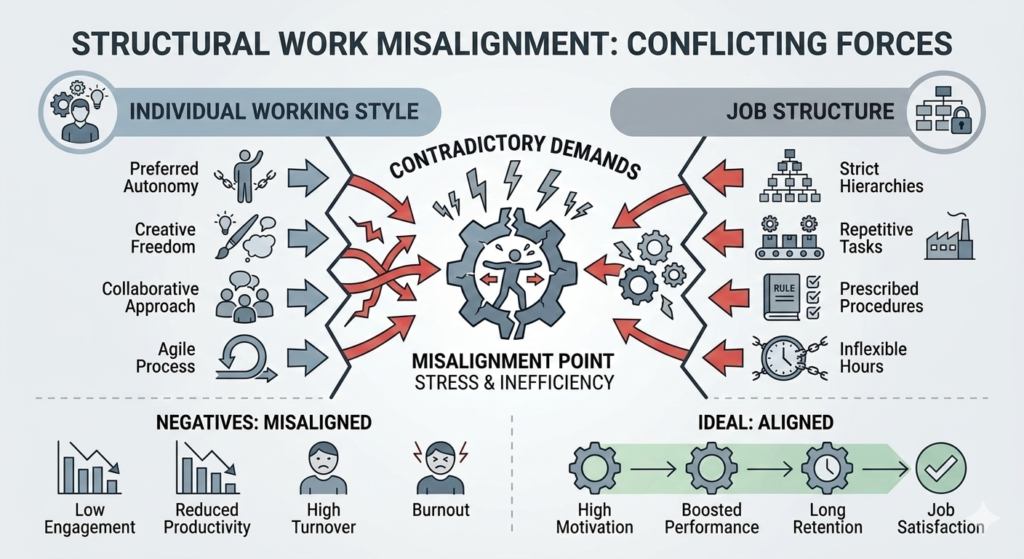
Structural misalignment occurs when the conditions of a role, including its tasks, growth paths, environment, and energetic demands, conflict with the way an individual naturally operates. Unlike acute problems such as a toxic manager or an unreasonable workload, structural misalignment is often subtle and cumulative. It manifests through patterns that are easy to misinterpret when viewed in isolation but become clear when examined through a diagnostic framework like the Pivoto work alignment diagnostic.
This article identifies the most common signs that a job is structurally misaligned and explains why recognizing these patterns is essential for making effective career decisions.
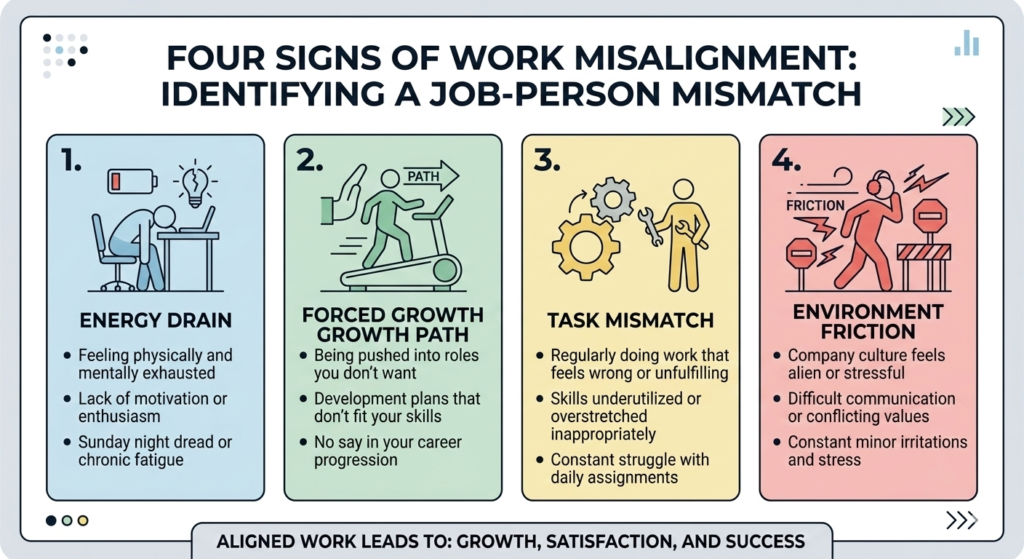
Constant Energy Drain
One of the clearest signals of structural misalignment is a persistent sense of energy depletion that cannot be explained by workload alone. Everyone experiences demanding periods at work. But when fatigue is chronic and disproportionate to the actual effort required, the cause is often structural rather than volumetric.
Structural energy drain occurs when the conditions of a role require a person to consistently operate against their natural grain. This might mean spending the majority of the day in a cognitive mode that does not come naturally, working in communication patterns that feel forced, or navigating decision-making processes that conflict with the way the person processes information. None of these individual frictions may be severe, but their cumulative effect is a steady depletion of energy that rest and time off cannot fully restore.
The distinguishing characteristic of structural energy drain is that it persists even when the workload is manageable. A person may have a reasonable number of tasks, adequate resources, and sufficient time, yet still feel exhausted by the end of each day. This pattern is frequently misdiagnosed as burnout caused by overwork when its actual origin is the misalignment between the person and the structural conditions of the role.
Growth That Feels Forced
A second common sign of structural misalignment is the experience of growth that feels obligatory rather than motivating. Professional development should, in principle, be energizing. Learning new skills, taking on greater responsibility, and advancing in one’s career are typically described as positive experiences. But when the growth structure of a role does not match a person’s natural development style, these experiences can feel like impositions.
This misalignment is particularly common in organizations with rigid, one-dimensional growth paths. If the only available path to advancement requires moving into management, professionals who are motivated by deepening expertise or expanding technical scope will experience the progression as a loss rather than a gain. They may comply with the expected trajectory because alternatives are not available, but compliance without alignment produces a characteristic feeling of forced development.
The same dynamic can occur in reverse. A person motivated by structured, hierarchical advancement may feel adrift in an organization that emphasizes lateral exploration and self-directed growth. The organization may offer abundant development opportunities, but if those opportunities do not align with the individual’s motivational pattern, they fail to produce genuine engagement.
Growth misalignment is often difficult to articulate because the available opportunities may look objectively good. This is why people experiencing this pattern frequently feel guilty or confused about their dissatisfaction. The problem is not the quality of the opportunities. It is the fit between the growth structure and the individual.
Tasks That Don’t Match Your Natural Working Style
Task misalignment is one of the most pervasive and least recognized forms of structural friction. It occurs when the nature, rhythm, or cognitive demands of daily work conflict with the way a person naturally processes information and sustains focus.
A common example is the mismatch between depth-oriented workers and roles that require constant context-switching. Some professionals are cognitively wired for sustained, focused attention on complex problems. When placed in roles that fragment their attention across multiple short tasks, frequent meetings, and rapid-response communications, they experience daily friction that degrades both their performance and their well-being. The tasks themselves may be within their capability. The structure of the tasks is what creates the misalignment.
The inverse is equally common. Professionals who thrive on variety and rapid transitions can feel trapped in roles that demand long stretches of singular focus. The work may be intellectually appropriate, but the rhythm of the tasks creates restlessness and disengagement.
Task misalignment is often invisible because organizations tend to define roles by responsibilities rather than by task structure. Two roles with identical responsibility sets can have very different task architectures depending on how the work is organized, how meetings are scheduled, how communication flows, and how projects are structured. Understanding task alignment requires looking beyond the job description to the actual daily experience of the work.
Environment Friction
Environmental misalignment produces a distinctive form of dissatisfaction that can be difficult to pinpoint because it often coexists with otherwise satisfying work. A person may enjoy their tasks, find their projects intellectually stimulating, and feel positive about their career trajectory, yet still experience a persistent undercurrent of friction. In these cases, the source is frequently the surrounding work environment rather than the work itself.
Environment friction can originate from numerous structural sources: a management style that conflicts with how the person prefers to receive direction, a team communication pattern that does not match their processing style, cultural norms that require constant social performance when they operate best with periods of independent work, or a physical or virtual workspace configuration that undermines their ability to concentrate.
What makes environmental misalignment particularly challenging is that it is often normalized. Organizations develop cultural defaults that become invisible to those who have adapted to them. A person who experiences friction with these defaults may interpret their discomfort as a personal failing rather than recognizing it as a structural mismatch. This is especially true in organizations with strong cultural identities, where dissatisfaction with cultural norms can feel like disloyalty rather than a legitimate signal of poor fit.
Why Career Choice Alone Doesn’t Solve Misalignment
One of the most consequential errors professionals make is assuming that structural misalignment can be resolved by changing careers. This assumption is understandable. When work feels draining, forced, or uncomfortable, the intuitive response is to conclude that the career itself is wrong. But structural misalignment is frequently independent of career choice. The Pivoto framework demonstrates this by evaluating alignment at the level of role structure rather than career category.
Consider a professional who leaves a marketing role at one company because it feels misaligned. If the misalignment originated from the task structure, growth path, or environment of that specific position, moving to a marketing role at a different company with different structural conditions could resolve the friction entirely. Conversely, changing careers altogether, for example moving from marketing to product management, could reproduce the same misalignment if the new role shares the same structural features that caused friction in the first place.
Career changes are sometimes necessary. But they are dramatically more effective when informed by a clear understanding of what specifically is misaligned. Without this understanding, career transitions often follow a pattern of serial dissatisfaction, where individuals move from role to role, experiencing temporary relief followed by the re-emergence of the same underlying structural friction. This pattern consumes years and significant emotional resources because it addresses the wrong variable.
How Work Alignment Diagnostics Identify These Patterns
The patterns described in this article are individually recognizable but systemically difficult to diagnose without a structured framework. Each sign of misalignment can be attributed to multiple causes, and the cumulative nature of structural friction makes it easy to normalize or dismiss individual signals. This is why diagnostic tools designed specifically for work alignment are valuable.
The Pivoto assessment evaluates each of the four structural dimensions of alignment, providing a detailed map of where friction exists and where fit is strong. Rather than offering a personality label or a career recommendation, the assessment identifies the specific structural conditions that are producing dissatisfaction. This precision is critical because it shifts the response from broad career questioning to targeted structural adjustment.
For individuals, this means being able to distinguish between a career problem and a structural problem. A person who understands that their dissatisfaction originates from growth misalignment, for example, can focus on finding or negotiating a different growth path rather than abandoning an otherwise well-suited career. For organizations, understanding structural alignment patterns across teams can reveal design issues in roles, management structures, or cultural practices that are driving avoidable turnover.
Recognizing the signs of structural misalignment is the first step toward addressing it. But recognition alone is insufficient without a framework that can translate vague dissatisfaction into specific, actionable information. Work alignment diagnostics provide this translation, converting subjective experience into structural insight that supports better career decisions.
You can explore the full Pivoto assessment to better understand your own work alignment patterns.