
What is Pivoto Work Alignment Assessment
Most professionals have experienced a puzzling disconnect: choosing what appears to be the right career, landing a role that matches their skills, and still feeling a persistent sense of dissatisfaction. Traditional career assessments focus almost entirely on interests and personality traits, offering broad suggestions about which industries or roles might be a good match. But they rarely address the structural conditions that determine whether a specific role will sustain someone over months and years.
Pivoto is a work alignment diagnostic designed to identify structural friction between individuals and their work environments. Unlike personality tests or career quizzes, the Pivoto assessment evaluates how tasks, growth structure, environment, and energy sustainability interact to shape long-term work satisfaction.
Traditional career assessments focus almost entirely on interests and personality traits, offering broad suggestions about which industries or roles might be a good match. But they rarely address the structural conditions that determine whether a specific role will sustain someone over months and years. The Pivoto work alignment assessment was designed to close that gap, measuring not who you are in the abstract, but how well the structural features of your work environment align with the way you naturally operate.
This article explains what the Pivoto assessment measures, how its framework is structured, and why understanding work alignment is more predictive of long-term career satisfaction than career choice alone.
What the Pivoto Assessment Measures
The Pivoto assessment is not a personality test. It does not attempt to classify individuals into types, nor does it generate broad career recommendations based on surface-level preferences. Instead, Pivoto evaluates the structural relationship between a person and their current or prospective work environment.
Specifically, the assessment examines four dimensions of alignment: how well day-to-day tasks match a person’s cognitive preferences, how the growth structure of a role fits their developmental style, how the surrounding environment supports or undermines their capacity to perform, and whether the overall configuration of the role is energetically sustainable over time.
The result is not a label or a type. It is a diagnostic map of where alignment exists and where friction is building. This distinction matters because structural misalignment is often invisible. People tend to attribute dissatisfaction to personal shortcomings or vague feelings of being in the wrong career. Pivoto reframes the problem as an engineering question: are the conditions of this role configured in a way that supports this specific individual?
This reframing has practical consequences. When dissatisfaction is treated as a personal problem, the typical response is to either push through or start over with an entirely new career. When it is treated as a structural problem, targeted interventions become possible. A person might adjust the composition of their daily tasks, negotiate a different growth trajectory, or shift into an environment that better matches their operating style. These are precise, actionable responses that depend on having precise, actionable diagnostic information.
The Four Alignment Pillars
The Pivoto assessment is organized around four core alignment pillars, each measuring a distinct structural dimension of work. Together, they form a comprehensive view of how well a role fits the person occupying it.
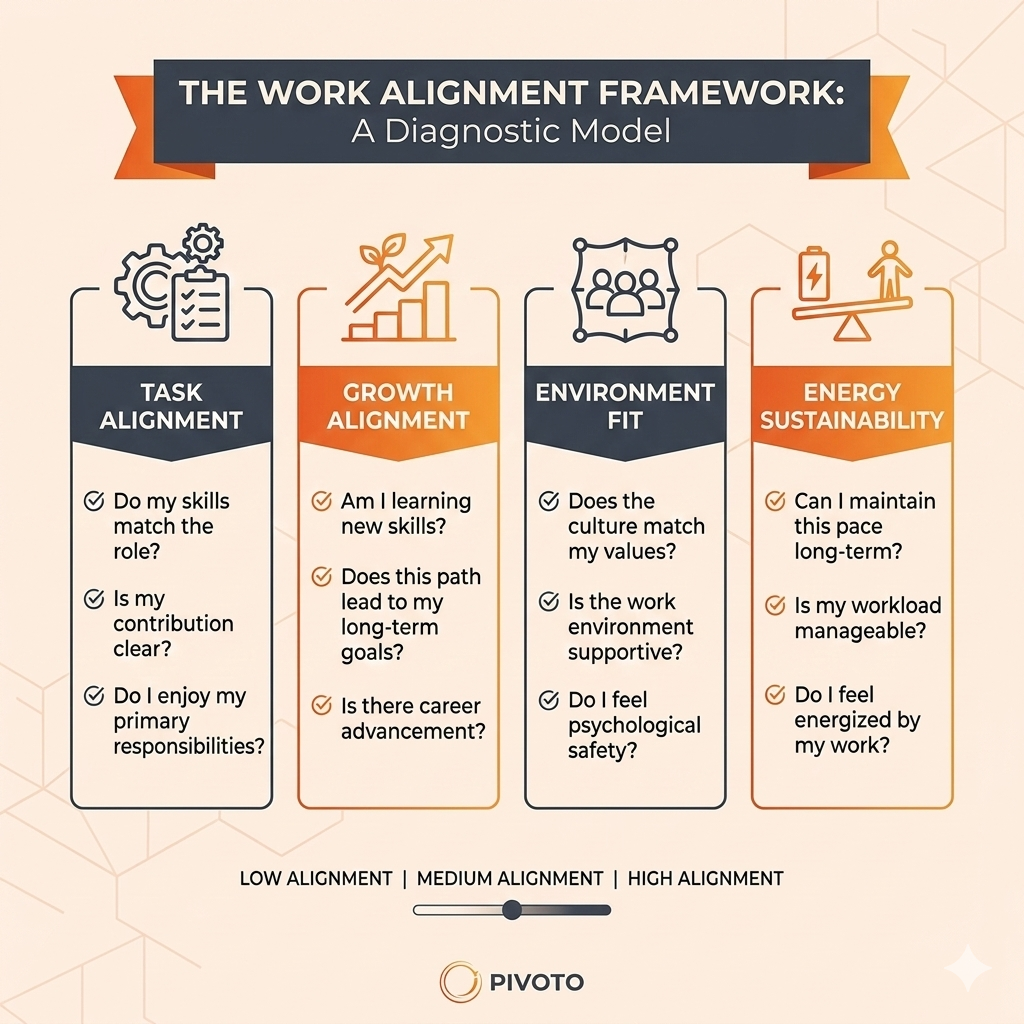
Task Alignment
Task alignment evaluates the degree to which the daily tasks of a role match a person’s natural working style and cognitive preferences. This is not about whether someone has the technical skills to perform a job. Skill fit and task alignment are different constructs. A person may be fully capable of executing their responsibilities while still experiencing chronic friction because the nature of the tasks conflicts with how they naturally process information, solve problems, or sustain focus.
For example, an analyst who thrives on deep, uninterrupted investigation may be technically competent in a role that requires constant context-switching between short tasks. But the mismatch between their preferred cognitive rhythm and the task structure of the role creates daily friction that accumulates over time. Task alignment captures this kind of structural tension, which skill-based assessments typically miss.
Growth Alignment
Growth alignment measures how well the progression structure of a role matches a person’s motivation and development style. Not all professionals are motivated by the same growth patterns. Some are driven by vertical advancement through clear hierarchies. Others are motivated by expanding the scope of their expertise. Still others find growth in lateral movement across domains or in deepening mastery within a narrow field.
A role that offers only one type of growth path will energize those whose style matches it and quietly drain those whose style does not. Growth alignment identifies this mismatch before it manifests as stagnation, disengagement, or the premature conclusion that a career change is needed.
Environment Fit
Environment fit measures how well the surrounding work context supports the individual. This includes team structure, management style, cultural norms, communication patterns, and the degree of autonomy afforded to the role. These factors are often treated as secondary to the job description itself, but research consistently shows that environment is one of the strongest predictors of job satisfaction and retention.
A person who operates best with high autonomy and minimal oversight will experience significant friction in a micromanaged environment, regardless of how well-suited they are to the role’s tasks. Conversely, someone who thrives with structured guidance and collaborative workflows may struggle in a decentralized, self-directed culture. Environment fit captures these dynamics as measurable structural variables rather than vague cultural descriptors.
Energy Sustainability
Energy sustainability is the integrative pillar. Rather than measuring a single dimension of work, it analyzes the net energetic effect of the interaction between tasks, growth structure, and environment. A role might score reasonably well on each individual pillar and still be unsustainable if the combination of factors creates a slow, cumulative drain.
This pillar is particularly important because energy depletion from structural misalignment is gradual. It often presents as creeping burnout, which individuals tend to attribute to personal resilience failures rather than structural causes. By measuring energy sustainability directly, the Pivoto assessment provides an early signal of whether a role is likely to remain viable over time.
What the Pivoto Report Reveals
After completing the assessment, individuals receive a detailed report mapping their alignment profile across all four pillars. The report does not prescribe a specific career or tell someone what job to pursue. Instead, it identifies where structural alignment is strong, where misalignment exists, and what specific dimensions of the work environment are contributing to friction. The Pivoto framework treats this information as diagnostic evidence, not personality classification.
The report is designed to make previously invisible patterns legible. Many professionals spend years cycling through roles, assuming the problem is their career choice, when the actual source of friction is a recurring structural pattern. Someone who consistently struggles in roles with rigid hierarchical growth paths, for example, does not need a career change. They need a role with a different growth structure. The Pivoto report makes these patterns visible and actionable.
In organizational settings, the report can also be used to evaluate role design. If multiple individuals in similar positions show alignment deficits in the same pillar, the issue may not be individual fit but structural design. This makes the Pivoto assessment useful not only for individuals but for teams and organizations seeking to reduce turnover and improve engagement.
Why Work Alignment Matters More Than Career Choice
The conventional approach to career satisfaction focuses heavily on choosing the right career. This framing assumes that if you select the correct field or occupation, the day-to-day experience will naturally follow. But decades of organizational research suggest otherwise. Satisfaction, performance, and longevity in a role are driven less by the career label and more by the structural conditions of the specific position.
Two marketing directors at different companies may share identical job titles and similar responsibilities but have radically different day-to-day experiences based on how their roles are structured. One might work in an environment with high autonomy, collaborative decision-making, and a growth path oriented toward expertise deepening. The other might face constant oversight, siloed workflows, and a growth structure that rewards only vertical promotion. The career choice is the same. The structural alignment is entirely different.
This is the core insight behind the Pivoto assessment: career satisfaction is not primarily a function of what you do, but of how the structural conditions of your role interact with your natural working style. By making these structural dynamics visible and measurable, Pivoto provides a more precise and actionable foundation for career decisions than traditional approaches based on personality types or interest inventories.
Understanding work alignment does not replace career exploration or skill development. It adds a critical structural layer that most career frameworks overlook. When people can see exactly where their work environment fits and where it creates friction, they make better decisions about which opportunities to pursue, which to avoid, and what to negotiate for within their current roles.
The practical implication is significant. Rather than approaching career decisions as a search for the right label, professionals can evaluate opportunities based on structural fit. Does the task structure match my cognitive preferences? Does the growth path align with how I am motivated to develop? Does the environment support my operating style? These are the questions that predict long-term satisfaction, and they are the questions the Pivoto assessment is designed to answer.