
Career misalignment happens when the structure of your work doesn’t match how you naturally think, work, or make decisions.
Many professionals feel something is “off” at work long before they understand why. The most common signs of career misalignment show up as energy drain, loss of meaning, or persistent friction with tasks, environment, or values.
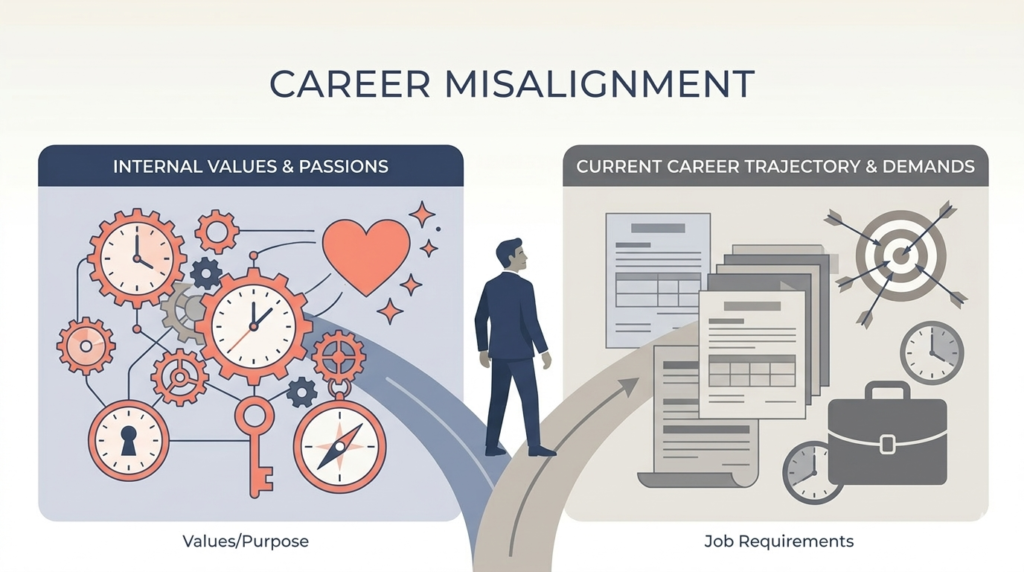
This guide explains what those signals look like and how to diagnose them before they turn into burnout.
These signals matter because they erode energy, learning, and health over time. Ignoring early warning signs usually slows career development and reduces performance; mild frustration can escalate into loss of focus or extended leave, which often looks like burnout but points to a deeper fit problem. Treat the three-question check as an early alert, not a final verdict.
Use this article as a concise diagnostic guide. Scan the common signs, run the short exercises below, and try a 15 to 60 minute experiment to test one recommended shift. It also outlines fast fixes and longer repairs so you can act now and plan next steps.
What you need to know
- Fast diagnostic: Start with three quick yes/no checks. If two or more answers are yes, gather evidence before making major changes.
- Emotional signals: Recurring meaninglessness, sluggish focus, and repeatedly bending your values are common signs of misfit. These patterns drain energy and stall career progress.
- Burnout versus misalignment: Burnout usually follows prolonged overload and chronic stress. Misalignment is a poor fit between your work and how you think, work, or decide, and it calls for a different response.
- Short experiments: Run two-week micro-experiments such as energy audits, task swaps, or small projects. They gather quick, actionable evidence about what changes help.
- Actionable next steps: Try a 15 to 20 minute alignment check and apply one to three targeted shifts this week. If experiments don’t show clear improvement, plan deeper moves and validate them over time.
Quick check: what are common signs of career misalignment?
Begin with a fast diagnostic. Answer these three yes/no questions without overthinking; they capture the most common signals coaches and professionals notice when roles stop fitting.
- Do you feel drained more days than energized? If you regularly need weekends to recover, the role is likely a net energy drain.
- Are your main tasks mismatched with your strengths? Feeling incompetent, bored, or ineffective on core duties usually indicates a skills-role mismatch.
- Do your values clash with team or company behavior? Frequent ethical friction or pretending to fit in signals values misalignment that wears you down over time.
If two or more answers are yes, treat this as a trigger to collect evidence rather than an immediate decision to quit. Try a short experiment or quick audit to see whether small changes provide relief, and expect some fixes to show improvement in days to weeks. Role changes and team moves can take months of planning and validation, so preserve income and test before making major changes.
Top emotional and behavioral warning signs
Misalignment usually shows up as recurring emotional and behavioral patterns rather than isolated bad days. A central sign is a loss of meaning: you complete tasks without feeling impact, you disengage frequently, or you cannot explain how your work helps anyone. Concrete behaviors include forwarding meeting notes without contributing ideas, dreading Mondays after a good weekend, or feeling that your work never changes anyone’s day.
Chronic energy drain looks different from a busy season. Watch for regular need for long recoveries, disrupted sleep, increased irritability, or new physical complaints that persist for weeks. Use the checklist below to separate a workload spike from a deeper fit problem.
- You need more than a weekend to “reset” after a normal week.
- Your energy dips are consistent, not tied to specific deadlines.
- Your mood affects personal relationships or basic self-care.
- Sleep or appetite changes accompany persistent work dread.
Misalignment also shows when your strengths sit unused or your work requires the opposite approach from how you perform best. For example, a strategic thinker forced into repetitive operations or an extroverted collaborator moved into isolated analysis will feel persistent friction even as skills improve. A culture or values mismatch compounds the problem; censoring yourself to fit in, disagreeing with routine choices, or feeling moral tension about decisions drains energy and damages trust.
How to tell misalignment from burnout
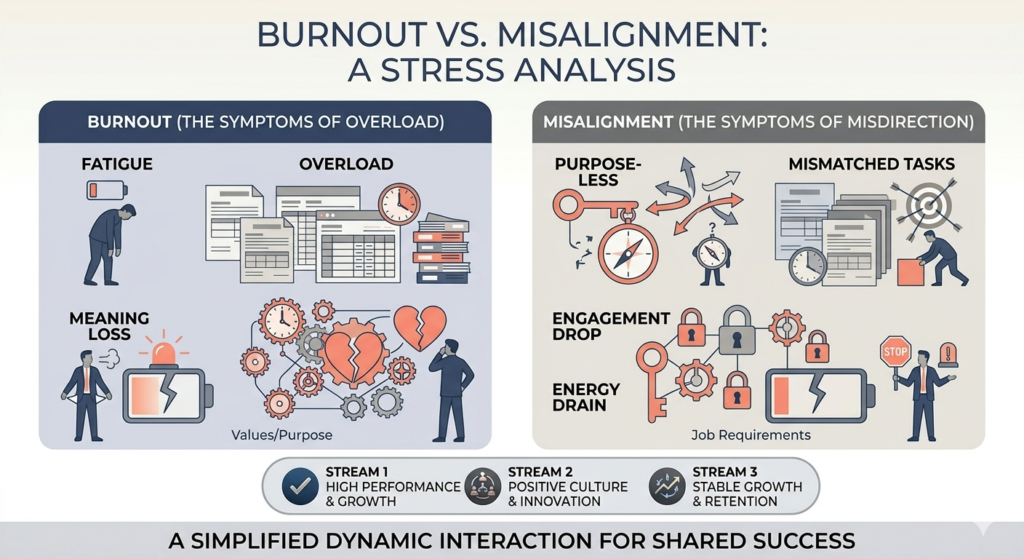
Burnout and misalignment can look similar, but the distinction matters for the response. Burnout usually follows prolonged overload and shows as persistent fatigue, cynicism about tasks, and short-term spikes in anxiety or sleep problems. Misalignment tends to feel like emptiness: lack of meaning, underused strengths, and chronic disengagement even with a light workload.
Try a rest test to check which pattern fits. Take a full week off or enforce strict work boundaries for seven days; if energy and interest return, the issue likely involves overload and recovery. If a substantial break leaves you flat, extend the rest period to three weeks of purposeful recovery and see whether anything shifts. If flatness persists, misalignment is more likely and you should consider role, task, or values changes rather than only rest.
Repeat a few quick self-checks while you test. After a long break, ask whether you feel restored and eager to work or still uninterested, and whether tasks drain you only during busier periods or routinely mismatch your strengths and values. Use these answers to form a working hypothesis before you try recovery steps or role edits.
Self-reflection exercises to confirm misfit
If you want a quick, evidence-focused answer to what are common signs of career misalignment, run these short exercises over two weeks. They require no coach and turn vague feelings into actionable patterns. The goal is clarity, not perfection.
Energy audit: Keep a simple 14-day task and mood log. For each work block, note the task, your energy before and after on a 1 to 5 scale, and one word for enjoyment. At the end of two weeks, group entries by task type or project to identify consistent energizers and drains.
Values inventory and redline list: Pick six to ten values such as autonomy, impact, learning, fairness, or stability and rank them. From your top ranks, create two to four non-negotiable redlines and map current role elements against each. Write one concrete recent example where a redline was breached to make misalignment tangible.
Strengths-use map and friction points: List your top strengths, mark where you actually use them, and note recurring friction. Distinguish underutilized strengths from healthy stretch opportunities. If core strengths repeatedly hit friction, treat that as a clear signal you may be stuck in the wrong role or career direction.
Short experiments and immediate adjustments
When work feels off, run two-week micro-experiments to identify which parts of your role energize you. Swap tasks with a peer, own a small project aligned to a clear strength, or take a different meeting role for ten working days. Track three signals: morning and end-of-day energy trends, satisfaction on a 1 to 5 scale, and objective performance markers such as deliverable quality or stakeholder feedback.
Resetting boundaries protects your capacity while you test fit. Start with reversible, low-cost changes like blocking two deep-work hours daily for two weeks, shortening recurring meetings, or delegating one low-value task for a trial period and logging the outcome. Frame requests as performance experiments so they sound like proposals to improve results rather than complaints.
When you speak with your manager, lead with evidence and a clear experiment. Try a script such as: “Data from the past two weeks shows my energy drops after Task A and rises after Task B. Can we test shifting 20 percent of my scope to B for two weeks and review the impact?” Offer a rollback plan and focus the conversation on measurable outcomes. A flat refusal or dismissal from leadership is itself diagnostic and should factor into your decision rule for scaling, iterating, or exiting the role.
When to consider bigger shifts and tools that help
Scale your response to realistic timelines and trade-offs. Small role tweaks and clarity experiments can produce useful results in a few weeks, guided experiments and reskilling often take a few months, and a full career pivot commonly requires three to twelve months depending on finances and learning needs. Build a plan that preserves income while you test new directions: protect runway, run micro-projects, then scale up after validated wins.
Pivoto Alignment Assessment provides a fast, evidence-first confirmation step if you want a concise read. The 15 to 20 minute check maps energizers, drains, and friction points and returns an Alignment Score plus a short PDF brief with one to three targeted shifts to try. Use that brief to design the micro-experiments above and weigh outcomes against your runway, transferable skills, support network, and market demand.
Decide among clear outcomes based on your experiments: stay and reshape if tests produce measurable improvement, change teams if the mismatch is mainly cultural, or change careers if structural limits block meaningful role crafting. If your runway is short or the stakes are high, consider a coach or a formal assessment to plan a safer pivot. Keep the decision criteria simple and repeat experiments until you have enough evidence to commit.
Spot the signs: what are common signs of career misalignment?
To answer what are common signs of career misalignment, start with a fast, honest check of your daily experience and a short set of evidence-gathering steps. If recurring emotional warning signs and predictable behavior changes appear, you’re more likely facing misalignment than a temporary rough patch.
Start today: answer the three diagnostic questions, run a 14-day energy audit or a short values inventory, and try one micro-experiment this week. Use the evidence you gather to decide whether to reshape your role, change teams, or plan a safer pivot. For broader reading on related workplace engagement trends and contextual signals, the research and trend summaries in industry reports can help triangulate your individual data with larger patterns.