
Career advice has historically centered on a deceptively simple premise: find what you love, develop the right skills, and professional satisfaction will follow. But this framework leaves a substantial blind spot. It does not account for the structural conditions that determine whether a role will sustain someone over time. Two people with identical skills and interests can occupy similar roles and have dramatically different experiences, not because of personal deficiency, but because of differences in how those roles are structurally configured.
Pivoto is a work alignment diagnostic designed to identify structural friction between individuals and their work environments. Unlike personality tests or career quizzes, the Pivoto assessment evaluates how tasks, growth structure, environment, and energy sustainability interact to shape long-term work satisfaction.
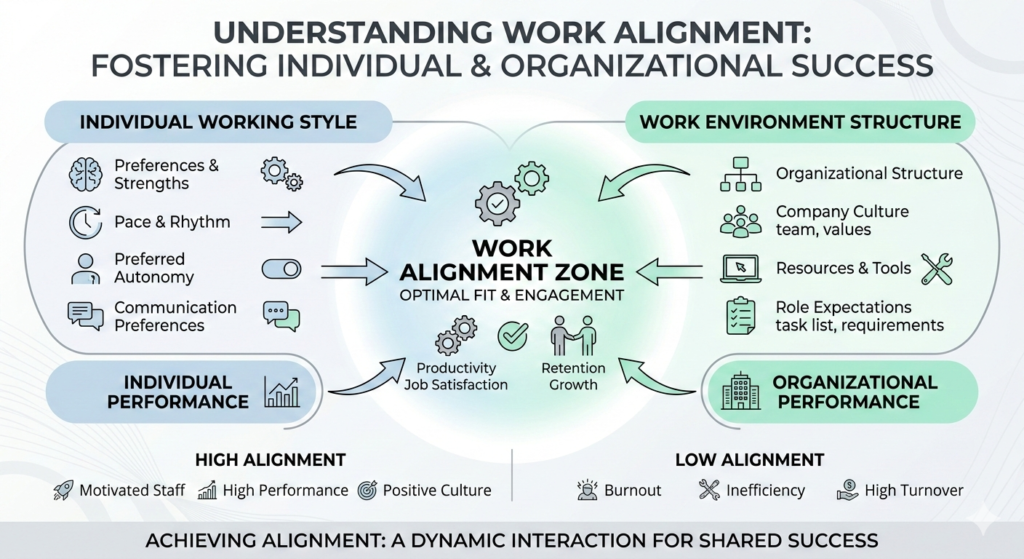
Work alignment is the concept that addresses this gap. It refers to the degree of fit between an individual’s natural working style and the structural features of their work environment. Unlike traditional career assessments, which focus on interests, traits, or aptitudes, work alignment evaluates the interaction between a person and the specific architecture of their role. The Pivoto work alignment diagnostic was built on this concept, providing a structured method for measuring alignment across the dimensions that most influence long-term satisfaction and performance.
Why People Feel Misaligned at Work
The experience of work misalignment is remarkably common and often misinterpreted. Professionals who feel chronically drained, disengaged, or restless in their roles frequently conclude that they have chosen the wrong career. This conclusion, while understandable, is often incorrect. In many cases, the career itself is a reasonable fit. The friction originates not from the occupation but from the structural conditions surrounding the work.
Structural misalignment can take many forms. A person may be in a role where the day-to-day tasks conflict with their preferred cognitive rhythm. They may be in an environment where the management style, communication patterns, or cultural expectations create persistent background friction. The growth path available to them may not match the way they are naturally motivated to develop. Or the overall configuration of the role may be slowly depleting their energy without any single factor being severe enough to identify in isolation.
The challenge is that structural misalignment is often invisible. Many professionals only recognize this pattern in hindsight, after years of assuming the problem was their career choice rather than the structure of their role. Because it operates at the level of daily conditions rather than dramatic events, it tends to manifest as a gradual decline in engagement and energy. People attribute this decline to burnout, lack of motivation, or personal inadequacy rather than recognizing it as a predictable consequence of poor structural fit. Understanding work alignment provides the vocabulary and framework to identify these patterns before they become crises.
The Difference Between Skill Fit and Work Alignment
One of the most important distinctions in the work alignment framework is the difference between skill fit and structural alignment. Skill fit refers to whether a person has the competencies required to perform a role effectively. Work alignment refers to whether the structural conditions of that role are compatible with the way the person naturally operates.
These are independent constructs. A person can have excellent skill fit and poor work alignment simultaneously. Consider a software engineer who is highly proficient in the technical requirements of their position but works in an environment characterized by constant interruptions, rigid process controls, and a growth path that leads exclusively toward management. Their skills match the role. The structure of the role does not match their working style. Over time, this misalignment produces chronic dissatisfaction that skill development alone cannot resolve.
Conversely, a person can have moderate skill fit but strong work alignment. If the structural conditions of the role match their natural rhythm, they are likely to develop skills faster, sustain engagement longer, and perform at a higher level than someone with superior technical skills operating in a misaligned environment. This is why organizations that hire exclusively on skill fit often experience higher turnover than expected. Skills are necessary but insufficient. Structural alignment is the multiplier.
The Four Structural Drivers of Work Alignment
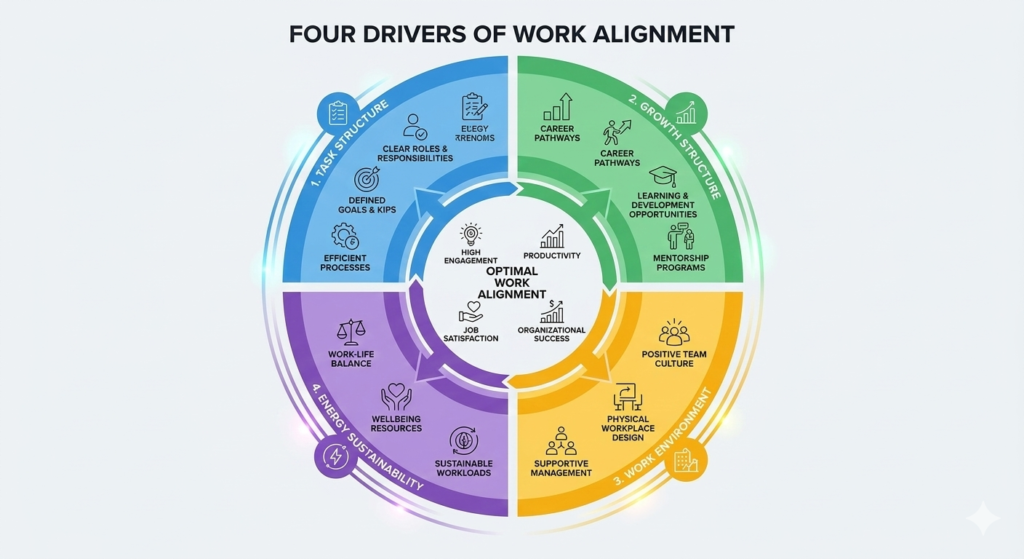
Work alignment is not a single dimension. It is the composite result of four structural drivers, each of which exerts independent influence on the sustainability of a role. Understanding these drivers individually is essential before evaluating how they interact.
Task Structure
Task structure refers to the nature, rhythm, and cognitive demands of the daily work itself. This includes the degree of variety in tasks, the depth of focus required, the pace of context-switching, the balance between creative and analytical work, and the proportion of time spent in execution versus planning. Task structure is distinct from job responsibilities. Two roles with identical responsibility sets can have very different task structures depending on how the work is organized.
Alignment with task structure means that the way work is organized matches the individual’s natural cognitive preferences. When this alignment exists, daily tasks feel engaging rather than depleting. When it does not, even tasks within a person’s area of expertise can create chronic fatigue.
Growth Structure
Growth structure refers to the progression paths and developmental opportunities embedded in a role. This includes formal advancement tracks, informal learning opportunities, mentorship availability, and the types of growth that are rewarded and recognized. Growth structure varies significantly across roles, teams, and organizations, and not all growth structures motivate all people equally.
Some individuals are primarily motivated by vertical advancement through clear, hierarchical promotion paths. Others find this structure confining and are motivated instead by expertise deepening, lateral movement, or increasing scope without changing rank. Growth alignment exists when the available progression structure matches the individual’s intrinsic motivation pattern. Misalignment in this dimension often manifests as a feeling of stagnation or forced development that does not feel personally meaningful.
Work Environment
Work environment encompasses the conditions surrounding the work itself: team dynamics, management style, organizational culture, communication norms, physical or virtual workspace, and the degree of autonomy and flexibility afforded to the individual. These environmental factors are frequently underweighted in career decisions despite being among the strongest predictors of job satisfaction in organizational research.
Environmental alignment is highly individual. A collaborative, consensus-driven culture may feel energizing to one person and suffocating to another. High autonomy may feel liberating or isolating depending on the individual. The work environment driver measures not whether a culture is objectively good or bad, but whether it is structurally compatible with the specific person operating within it.
Energy Sustainability
Energy sustainability measures the cumulative energetic impact of the other three drivers over time. A role can be tolerable in each individual dimension but unsustainable in aggregate. Energy sustainability captures this interaction effect by evaluating whether the total configuration of the role produces a net energy gain or drain for the individual.
This driver is particularly valuable for detecting slow-onset misalignment. Roles that are moderately misaligned across multiple dimensions often feel manageable in the short term but produce a steady energy deficit that compounds over months and years. Energy sustainability acts as the integrative signal that accounts for these cumulative effects.
How the Pivoto Framework Evaluates Work Alignment
The Pivoto framework operationalizes work alignment by measuring each of the four structural drivers through a diagnostic instrument designed to capture both individual preferences and environmental conditions. The result is not a personality profile or a career recommendation. It is a structural alignment map that shows where fit exists and where friction is present.
What distinguishes the Pivoto approach from traditional career tools is its focus on the interaction between person and structure rather than on the person alone. A personality assessment can tell you that you prefer autonomy. It cannot tell you whether the specific role you occupy provides the type and degree of autonomy that matches your operating style. Work alignment diagnostics close this gap by evaluating the fit between individual and environment as a system rather than measuring either component in isolation.
The framework is designed to be diagnostic, not prescriptive. It identifies misalignment without telling people what career to pursue. This is intentional. Structural misalignment can often be resolved within a current role through targeted adjustments rather than wholesale career changes. By providing precise information about where friction exists, the Pivoto framework enables more calibrated and effective responses to work dissatisfaction.
Why Structural Alignment Matters for Career Sustainability
Career sustainability is the ability to maintain engagement, performance, and well-being in one’s work over extended periods. It is distinct from career success, which is typically measured by external markers such as title, compensation, and status. A person can achieve conventional career success while experiencing declining engagement and escalating fatigue if the structural conditions of their work are misaligned.
Structural alignment directly influences career sustainability because it determines the daily energetic cost of work. When alignment is strong, the conditions of the role support natural performance. Energy is replenished through the work itself, and periods of high demand are balanced by conditions that restore capacity. When alignment is weak, every workday imposes an additional energetic tax that accumulates over time, regardless of how successful the person appears externally.
This is why structural alignment should be a primary consideration in career decisions, not an afterthought. The Pivoto assessment provides the diagnostic precision to evaluate alignment before dissatisfaction becomes chronic. Whether applied to a current role or a prospective opportunity, understanding the structural fit between person and position is one of the most practical tools available for building a career that is not only successful but sustainable.
You can explore the full Pivoto assessment to better understand your own work alignment patterns.